
16 October 2026
What is the NJR – and why am I signing another consent form?
Why you may be asked to consent to your details being held on the National Joint Registry, what the registry records, and why consenting is entirely voluntary.
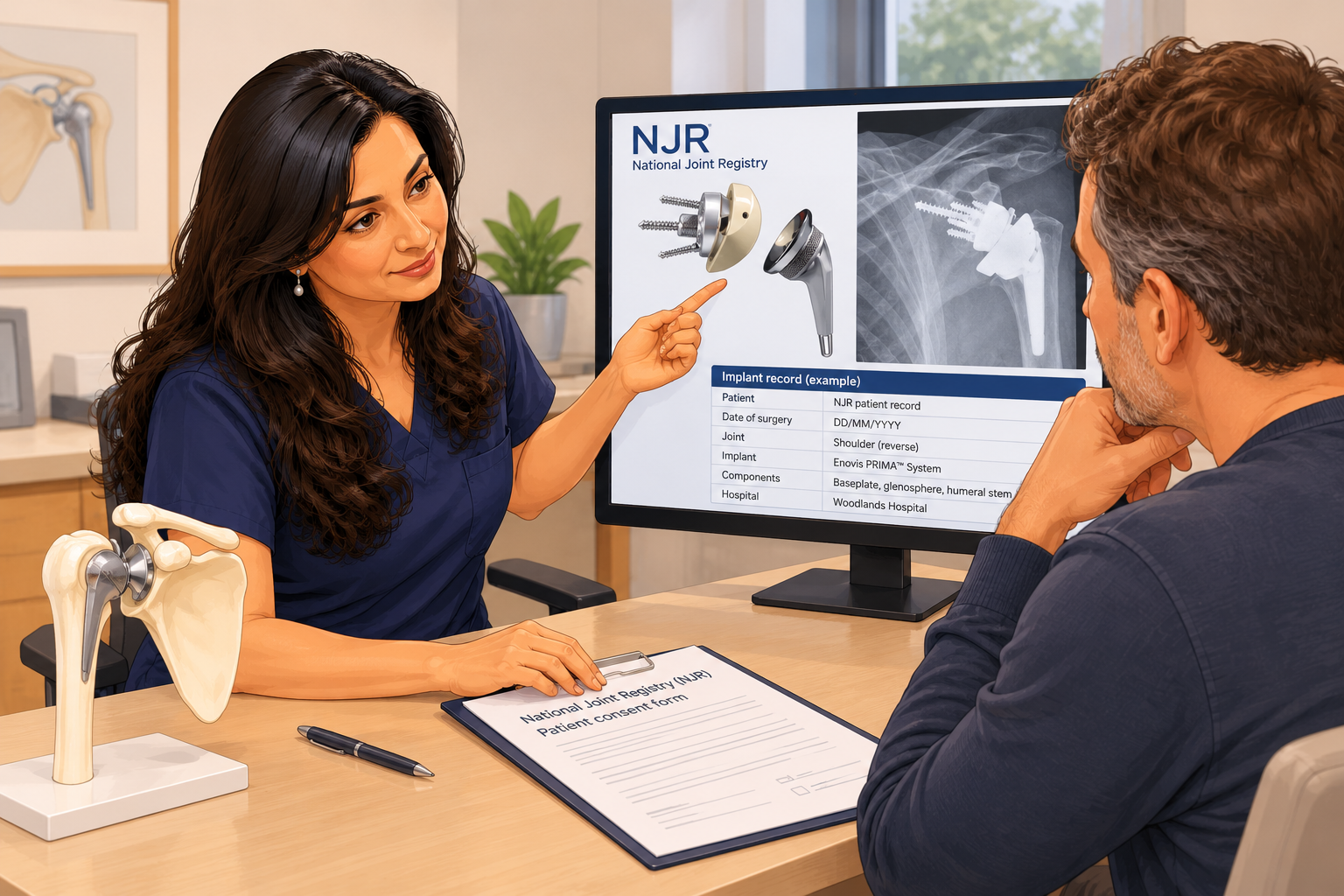
If you’re having a shoulder replacement, amongst all the paperwork you’re given you may find another form asking for your consent for your details to be entered onto the National Joint Registry (NJR).
So what exactly are you consenting to, and why does it matter?
What is the National Joint Registry?
The National Joint Registry is a huge database recording joint replacement surgery. It has been running since 2003 and now contains millions of joint replacement records.
It doesn’t just record hips and knees. Shoulder, elbow and ankle replacements are also included.
When I perform a shoulder replacement, information is recorded about the operation and, importantly, the actual implants that I have used. Over time, having such a large amount of information allows us to see how different joint replacements are performing and how long they are lasting.
It also gives us something incredibly important: traceability.
Why does traceability matter?
Joint replacements are designed to last for many years, and problems with a particular implant may not become apparent immediately.
A good historical example is the DePuy ASR metal-on-metal hip system. Data from the NJR helped identify that some of these implants were requiring revision more frequently than expected. The NJR alerted the MHRA in 2010 and the implants were subsequently recalled worldwide.
Because patients and their implants had been recorded, it was possible to identify people who had received the affected implants so that they could be followed up.
Thankfully, situations like this are unusual. But if a concern were ever identified with a particular shoulder replacement — perhaps many years after your operation — knowing exactly which implant you have is enormously valuable.
So why do I need to consent?
Hospitals performing joint replacements are required to submit information about these operations to the NJR. However, you don’t have to consent to your personal details being held on the registry.
The additional consent form is asking whether you are happy for information that identifies you to be recorded alongside the details of your operation and implants.
If you consent, the registry can link you to your particular joint replacement. That means that if a problem with an implant were ever identified in the future, you could be identified for follow-up through your hospital.
If you don’t consent, it won’t affect your treatment in any way. Information about the operation and implant can still be recorded, but without your personal details attached, which means that the NJR cannot trace that implant back to you individually.
You can also change your mind and withdraw your consent later.
Does the NJR do anything else?
Yes — and this is perhaps the bit patients don’t necessarily see.
With millions of joint replacements recorded, the NJR can look at how implants perform over many years. It helps us understand which replacements are lasting well, identify implants that aren’t performing as expected, monitor outcomes and ultimately helps surgeons make better-informed choices about the implants we use.
As a shoulder surgeon, this sort of information is extremely useful. An implant can look excellent in theory or produce very good early results, but what really matters is how it performs in thousands of patients over many years.
So should I consent?
It is entirely your choice.
I would encourage my patients to consent because I think the registry is an important part of making joint replacement surgery safer. The more complete the information we have, the better we can understand how our implants are performing — and, importantly, we retain the ability to identify patients if a problem ever emerges in the future.
But consenting is voluntary, and choosing not to will never affect the treatment you receive from me.
So when I give you yet another consent form to sign before your shoulder replacement, it isn’t simply another piece of hospital paperwork.
It’s part of a system designed to keep track of the joint replacement I put into your shoulder, not just today, but for the years ahead.
Written by Miss Aparna Viswanath, Consultant Shoulder & Upper Limb Surgeon. General information only, not individual medical advice.
Book an appointmentBack to all articles