
What it is
Calcific tendinitis is a condition where calcium deposits develop within one of the rotator cuff tendons. It is a surprisingly common cause of shoulder pain and can affect people who have never had a shoulder injury. Although the exact cause is not fully understood, calcific tendinitis is usually not the result of calcium in your diet or of “wear and tear”. In many cases the body will eventually reabsorb the calcium naturally, but this process can take time and symptoms can vary considerably from person to person.
How it usually presents
- A gradual ache over several weeks or months in many patients
- In others, a sudden episode of extremely severe pain, often without warning
- During an acute phase, even the smallest movement can be difficult
- Sleeping on the affected shoulder may become impossible
How it is assessed
The first step is confirming the diagnosis. A careful assessment, combined with simple X-rays and, where appropriate, ultrasound, will usually identify the calcium deposit and help determine the most appropriate treatment.
Treatment options
- Pain relief and activity modification during the painful phase
- Specialist physiotherapy
- An ultrasound-guided steroid injection to settle the inflammation surrounding the deposit
- Ultrasound-guided needle barbotage of the calcium deposit
- Arthroscopic (keyhole) surgery in a minority of cases
Ultrasound-guided needle barbotage
For patients whose symptoms remain severe or persistent, ultrasound-guided needle barbotage can be an excellent minimally invasive treatment. Using ultrasound to accurately identify the calcium deposit, a fine needle is inserted into the tendon to gently break up and wash out the calcium. A small steroid injection is often given afterwards to reduce inflammation and improve comfort.
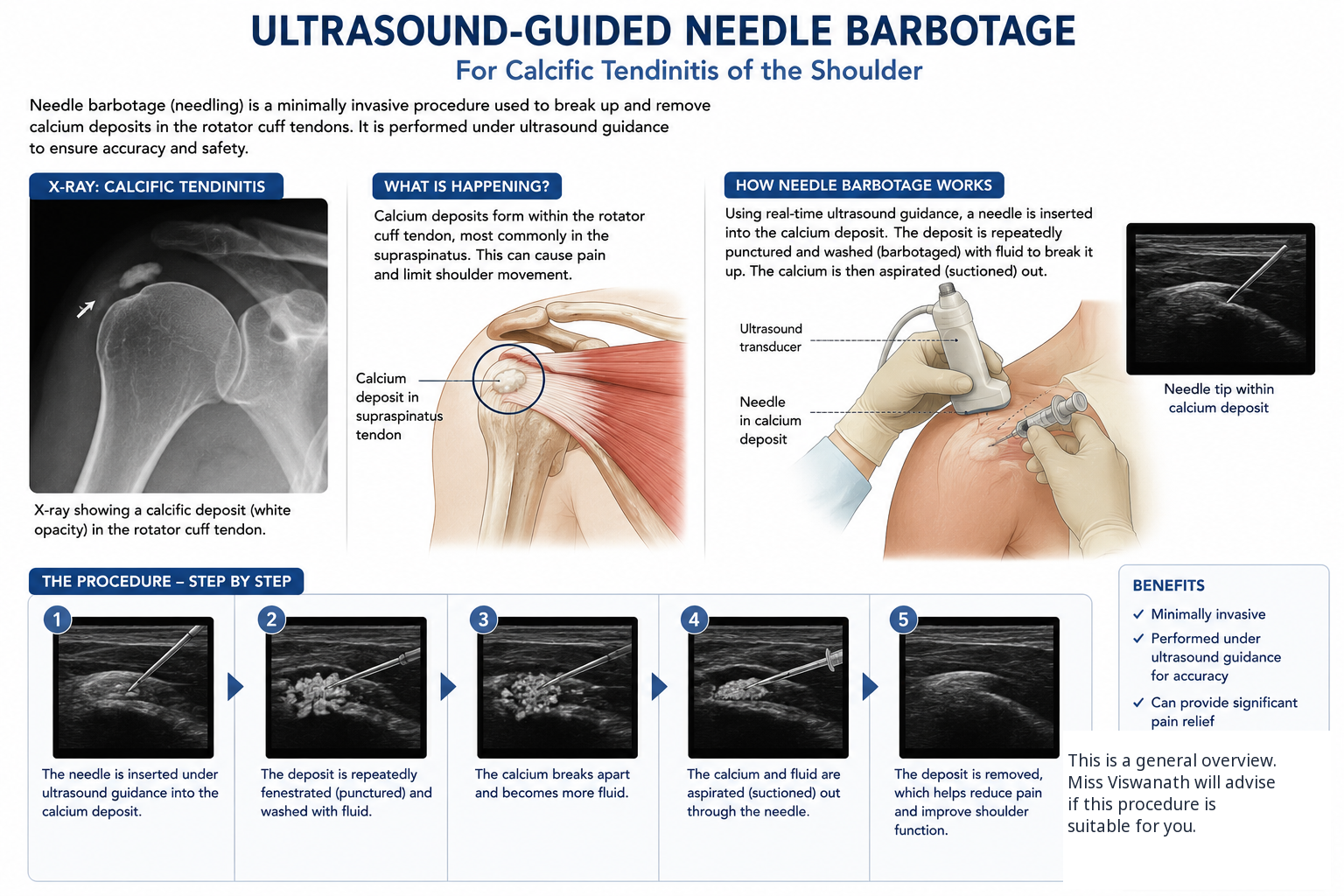
This procedure can provide significant pain relief and often allows patients to begin rehabilitation much more comfortably. However, removing the calcium is only part of the treatment.
Following ultrasound-guided needle barbotage, physiotherapy remains an important part of recovery. Restoring normal shoulder movement, rebuilding rotator cuff strength and improving muscular control helps the shoulder recover fully and reduces the risk of ongoing symptoms.
Do I need surgery?
Most patients improve without the need for surgery. However, if symptoms continue despite appropriate non-surgical treatment, arthroscopic (keyhole) surgery can be considered to remove the remaining calcium and address any associated rotator cuff problems.
My aim is to determine which stage of the condition you are experiencing and help you choose the treatment that is most likely to provide lasting relief. Together, we can decide whether physiotherapy, injections, barbotage or, occasionally, surgery is the most appropriate next step.
Back to all conditions