
What it is
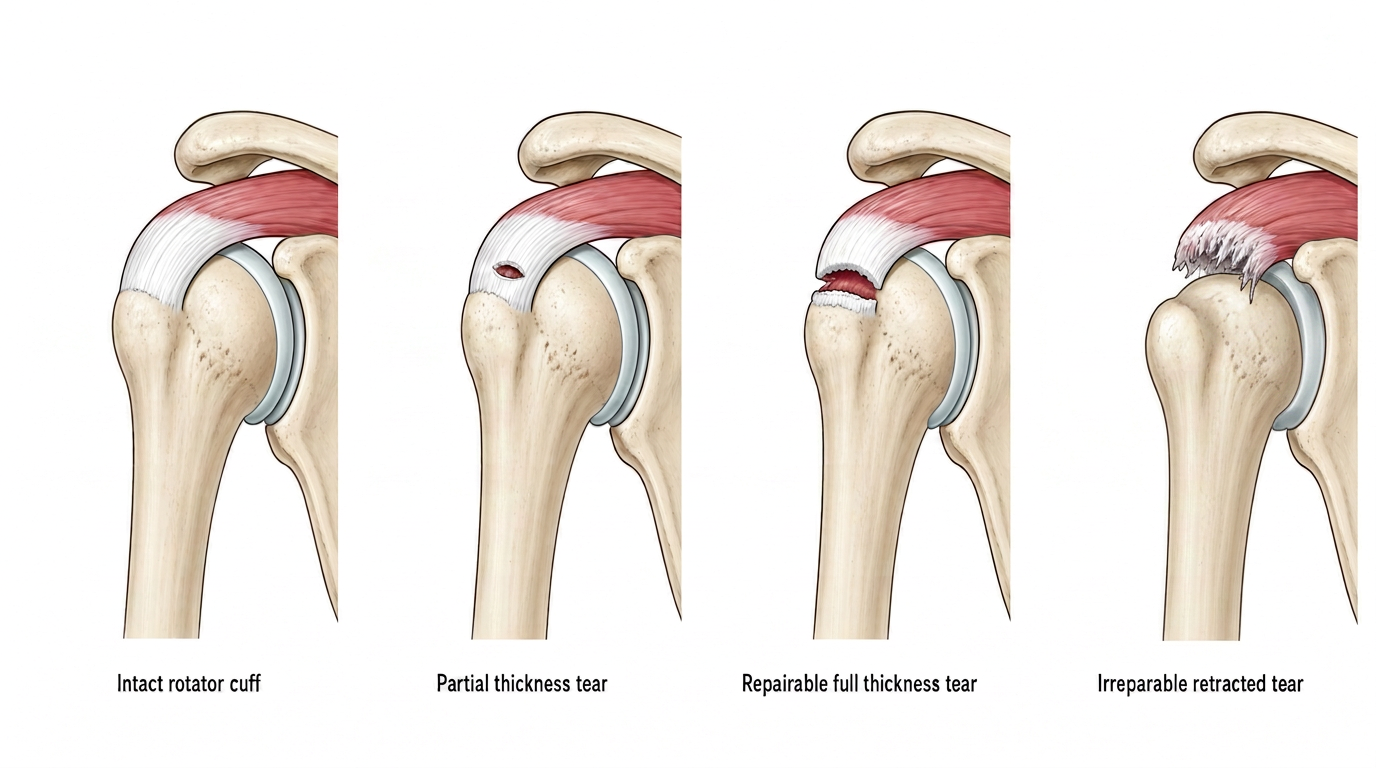
The rotator cuff is a group of four muscles and tendons that work together to stabilise the shoulder and help lift and rotate the arm. Tears within these tendons are common and become increasingly frequent over time. In fact, many people have a rotator cuff tear without ever knowing about it. Rotator cuff tears vary considerably. Some are partial tears, where only part of the tendon is damaged, while others are full-thickness tears, where the tendon has completely detached from the bone. Some tears develop gradually over many years, whereas others occur suddenly following a fall or injury. Occasionally, a relatively minor injury causes a previously healthy tendon to fail, or a new injury may extend an existing long-standing tear — what we often refer to as an acute-on-chronic tear.
How it usually presents
- Pain over the outer upper arm, especially at night
- Weakness lifting the arm or holding it out to the side
- Difficulty with overhead tasks and hair washing
- A sudden loss of power after a fall or injury
How it is assessed
Examination of the individual cuff tendons, with ultrasound or MRI to confirm the size, position and quality of the tear.
Do I need a scan or surgery?
Not every rotator cuff tear requires surgery. The decision depends on several factors, including how long the tear has been present, activity level, the cause of the tear, the amount of pain and weakness you are experiencing, and whether the tendon is likely to be repairable. A careful history, examination and appropriate imaging help us decide which treatment is most likely to give you the best outcome.
Treatment options
- Physiotherapy to recruit the remaining tendons
- Subacromial injection to settle pain and allow rehabilitation
- Arthroscopic rotator cuff repair for suitable tears
- Tendon transfer or reverse replacement for very large, long-standing tears
Understanding the rotator cuff
Physiotherapy is often the cornerstone of treatment
For many patients, physiotherapy remains the cornerstone of treatment. Even when a tear is present, strengthening the remaining muscles around the shoulder and improving movement patterns can significantly reduce pain and restore function.
Some patients also benefit from ultrasound-guided injections to help control inflammation and allow rehabilitation to progress more comfortably.
Arthroscopic (keyhole) rotator cuff repair
If the tendon has been torn following an injury, or if pain and weakness continue despite appropriate non-surgical treatment, arthroscopic (keyhole) rotator cuff repair may be recommended. During surgery, the torn tendon is mobilised and repaired back onto the bone using small anchors placed into the humerus. The aim is to restore the normal attachment of the tendon and give it the opportunity to heal.
When a tear cannot be repaired
Unfortunately, not every tear can be repaired. Some irreparable rotator cuff tears have become too retracted, or the tendon and muscle have undergone changes that make a durable repair impossible.
In these situations there are still a number of treatment options available, ranging from specialist physiotherapy and injections to more advanced reconstructive procedures or, in some patients, reverse shoulder replacement. The most appropriate treatment depends on your symptoms, your functional goals and the condition of the rest of your shoulder.
Recovery after a rotator cuff repair
Following a rotator cuff repair, your arm will usually be supported in a sling for around four weeks to protect the repair while the tendon begins to heal. Physiotherapy starts early, initially concentrating on gentle movement before gradually progressing to active exercises and strengthening.
Although everyone recovers at a different rate, many patients begin driving at around six weeks, although in reality it is often eight weeks or longer before they feel confident and comfortable enough to control a vehicle safely.
Strengthening exercises usually begin before this, but heavy lifting, manual work and strenuous activities are often delayed until around three months, allowing the repair time to heal securely.
My role in your care
My role is not simply to tell you whether you have a rotator cuff tear, but to help you understand whether that tear is actually responsible for your symptoms and, if it is, whether the best treatment is physiotherapy, an injection, surgery or careful observation. Together, we can choose the option that best matches your shoulder, your lifestyle and your goals.
A rotator cuff tear on an MRI scan does not automatically mean you need surgery. Many tears can be managed successfully without an operation, while others benefit from early repair. The key is understanding which type of tear you have and how it relates to your symptoms.
Patient FAQs
Related conditions
Impingement and bursitis
Painful pinching of the cuff and bursa under the acromion.
Read about impingement and bursitisCalcific tendonitis
Calcium deposits in the cuff causing sudden, severe pain.
Read about calcific tendonitisShoulder (glenohumeral) arthritis
Wear of the ball-and-socket joint causing pain and stiffness.
Read about shoulder (glenohumeral) arthritis